About Two Stroke Petrol Engine Model
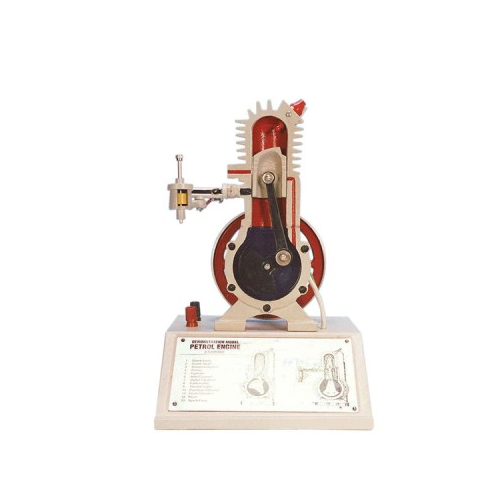
PETROL ENGINE WORKING MODEL
The Petrol Engine Working Model is an educational laboratory apparatus designed to demonstrate the construction and working principles of a single-cylinder internal combustion petrol engine. It helps students understand engine components, piston movement, crankshaft operation, and power generation mechanisms through visual demonstration.
FEATURES
Durable metal construction
Clearly visible moving parts
Demonstrates engine working principles
Compact and sturdy design
Suitable for classroom demonstrations
Low maintenance operation
APPLICATIONS
Engineering colleges
Technical institutes
Physics laboratories
Automobile training centers
Educational demonstrations
BENEFITS
Enhances practical learning
Improves understanding of engine mechanisms
Easy to operate and demonstrate
Long service life
Ideal for training and educational purposes
Visualize Internal Engine MechanismsThanks to its cut-section design and movable parts operated by a hand crank, this model lets users examine the full internal motion of a two-stroke petrol engine. Clear paint markings highlight each core component, making it ideal for instruction and hands-on demonstration in laboratories or workshops.
Ready for Immediate UseWith no assembly required, this demonstration model is ready for action straight out of the box. An included instruction manual assists with operational guidance, while the sturdy construction and corrosion-resistant paint guarantee enduring performance in training environments.
Perfect for Educational EnvironmentsSpecially tailored for technical institutions and engineering workshops, this model aids in the detailed study of engine operations. It offers a tangible alternative to digital simulations, enhancing student understanding through direct, manual interaction with engine components.
FAQ's of Two Stroke Petrol Engine Model:
Q: How does the Two Stroke Petrol Engine Model help in understanding engine mechanics?
A: The model features a sectional design and movable parts, making internal engine operations visible and interactive. By turning the hand crank, users can simulate the engine's motion, providing a clear and engaging representation of a functioning two-stroke petrol engine for educational purposes.
Q: What is the primary application of this engine model?
A: This demonstration model is primarily intended for technical institutions, engineering laboratories, and training workshops as a visual teaching aid. It is not a working engine but a manual, hands-on tool for studying and explaining engine structure and motion.
Q: When should this model be used during instruction or training?
A: This engine model is best utilized in lessons or laboratory sessions focusing on engine internals, two-stroke engine operation, or mechanical systems. It's ideal for demonstrations, student projects, or as a reference during practical assessments.
Q: Where can the model be displayed or used?
A: Designed with compact dimensions and a sturdy stand, the model is suitable for laboratory desks, classroom counters, and training benches. Its corrosion-resistant paint allows for safe use and storage in a variety of educational settings.
Q: What is involved in maintaining the model?
A: Maintenance is straightforward and minimal. The model only requires occasional dusting to keep the metal and plastic components clean. Its corrosion-resistant paint further protects it from typical laboratory wear and tear.
Q: How do the painted sections and labeling benefit students?
A: Painted and clearly marked internal parts enhance visual identification and aid in distinguishing between the various engine components, streamlining the learning process and making the structure easier to study and understand.
Q: What process should be followed to use the model for demonstration?
A: Simply place the model on a stable surface, refer to the included instruction manual, and use the hand crank to simulate engine motion. All core components are visible for explanation, making it simple for instructors to demonstrate key engine cycles and structures.






 Send Inquiry

 Send Inquiry
 Send Inquiry
 Send SMS
 Call Me Free